







Physical inactivity remains one of the major health challenges of our time. Despite decades of research on motivation and behavior change, many individuals still struggle to engage in regular physical activity. A crucial factor lies in people’s reluctance to invest effort due to its perceived cost and aversiveness. The readiness to accept and sustain effort appears to be a key determinant—if not even the game changer—that distinguishes activity from inactivity and, in performance-oriented sport, often determines whether individuals reach their potential or fall short of it.
In this talk, effort is understood as energy directed toward the attainment of a goal, and thus as a fundamental principle of human action. It lies at the core of motivation and shapes how we act, persist, achieve, and even find meaning in what we do. We may therefore be well advised to make effort feel easier—without reducing the actual effort itself.
Drawing on motivational and volitional approaches, the talk will illustrate that effort can be “eased” through changes in the perceived intensity of effort (e.g., via planning or self-talk), but more importantly, through changes in the valence of effort itself (e.g., through autonomy support or motive–goal alignment).
The positive valence of effort helps explain why effort can, at times, even feel effortless—as in states of flow—and how, when linked to rewards and the satisfaction of basic psychological needs, effort may transform from something to be avoided into something inherently valuable, even preferred.
The talk concludes with the assumption that a better understanding of how effort can be experienced more positively may open new pathways for designing environments, interventions, and mindsets that foster physical activity and high performance—by transforming effort from a barrier into a source of energy and meaningful goal pursuit.
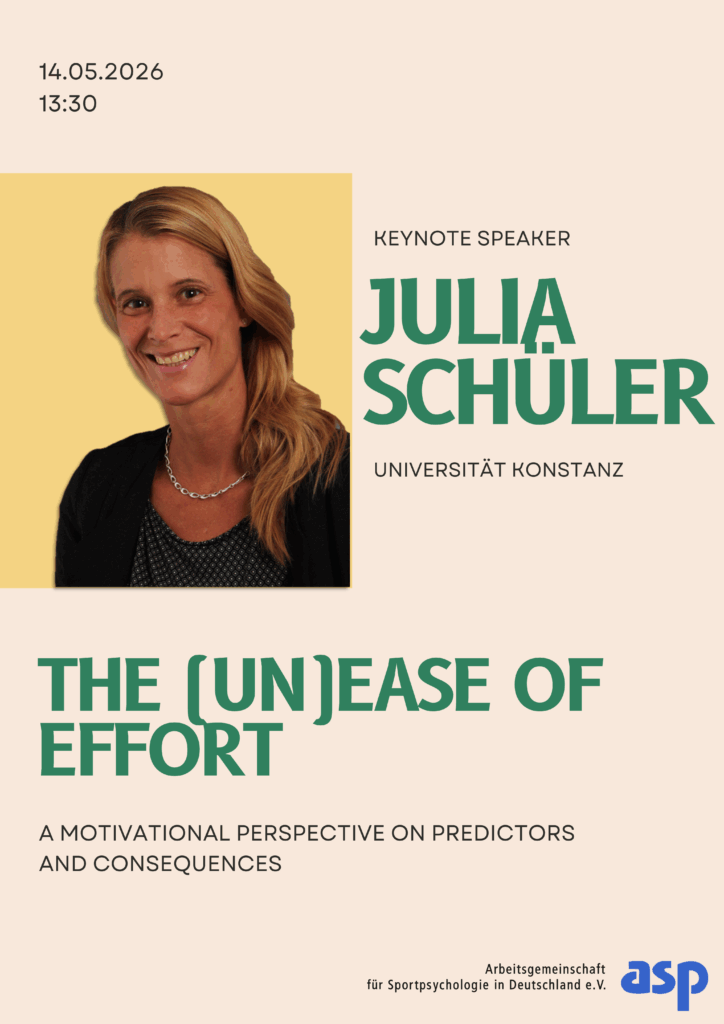
Julia Schüler is a Professor of Sport Psychology at the University of Konstanz, Germany.
She holds a PhD in Psychology from the University of Wuppertal, where she specialized in motivation psychology. Before joining the University of Konstanz in 2016, she held academic positions at the University of Zurich (Senior Assistant) and the University of Bern (Assistant Professor) and was a research fellow at the University of Rochester, USA.
Her research adopts a psychoneurophysiological perspective to investigate motivational and self-regulatory processes, such as intrinsic motivation and self-control, mainly in health and exercise contexts, both in laboratory and real-life settings. She has received research grants from the German Research Foundation (DFG) and the Swiss National Science Foundation (SNF) and serves as reviewer for leading journals in psychology.
Julia Schüler is committed to mentoring early-career researchers and advancing gender equality in academia. She also contributes to academic self-governance as the current chair of the Sport Psychology Division of the German Psychological Society (DGPs).
Prävention und klimabewusstes Handeln teilen eine entscheidende Gemeinsamkeit: Beide erfordern Entscheidungen, bei denen kurzfristige Kosten gegen langfristigen, oft kollektiven Nutzen abgewogen werden. Gesundheitskommunikation ist dabei das zentrale Scharnier zwischen Wissen und Handeln. Doch was macht sie wirksam, und was bringt sie zum Scheitern? Anhand von Befunden aus der Gesundheits- und Klimakommunikation werden übergreifende Prinzipien wirksamer Kommunikation abgeleitet und ihre Bedeutung für die Politikberatung diskutiert.
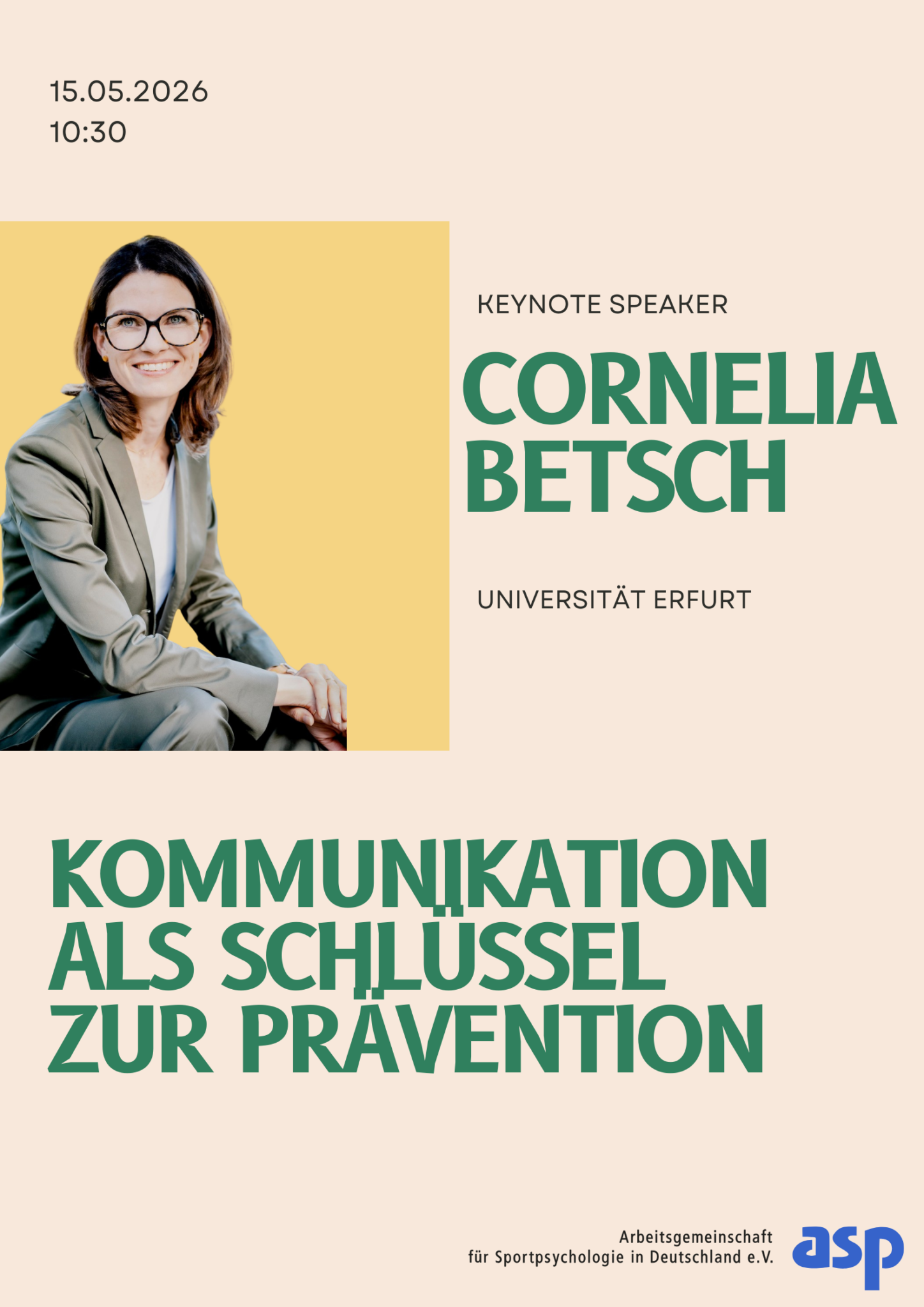
Fotograf: Marco Borggreve
Cornelia Betsch ist Professorin für Gesundheitskommunikation und Direktorin des Institute for Planetary Health Behaviour an der Universität Erfurt. Zudem leitet sie die Arbeitsgruppe Gesundheitskommunikation am Bernhard-Nocht-Institut für Tropenmedizin in Hamburg.
Als promovierte Psychologin forscht sie zu gesundheits- und klimagesundem Verhalten, z.B. zur Handlungsbereitschaft gegen die Klimakrise, zum umsichtigen Gebrauch von Antibiotika und zum Impfverhalten. Während der Corona-Pandemie initiierte sie das COVID-19 Snapshot Monitoring (COSMO) und später die Planetary Health Action Survey (PACE), mit denen Wissen, Risikowahrnehmung und Schutzverhalten in der Bevölkerung untersucht werden.
2017 gründete sie den ersten Masterstudiengang Gesundheitskommunikation in Deutschland. Für ihre wissenschaftlichen Leistungen erhielt sie den Deutschen Psychologiepreis und den Thüringer Forschungspreis. Prof. Dr. Betsch ist Mitglied des Deutschen Ethikrats und hat das WHO Collaborating Center zu Behavioural Research in Global Health (BRIGHT) etabliert.
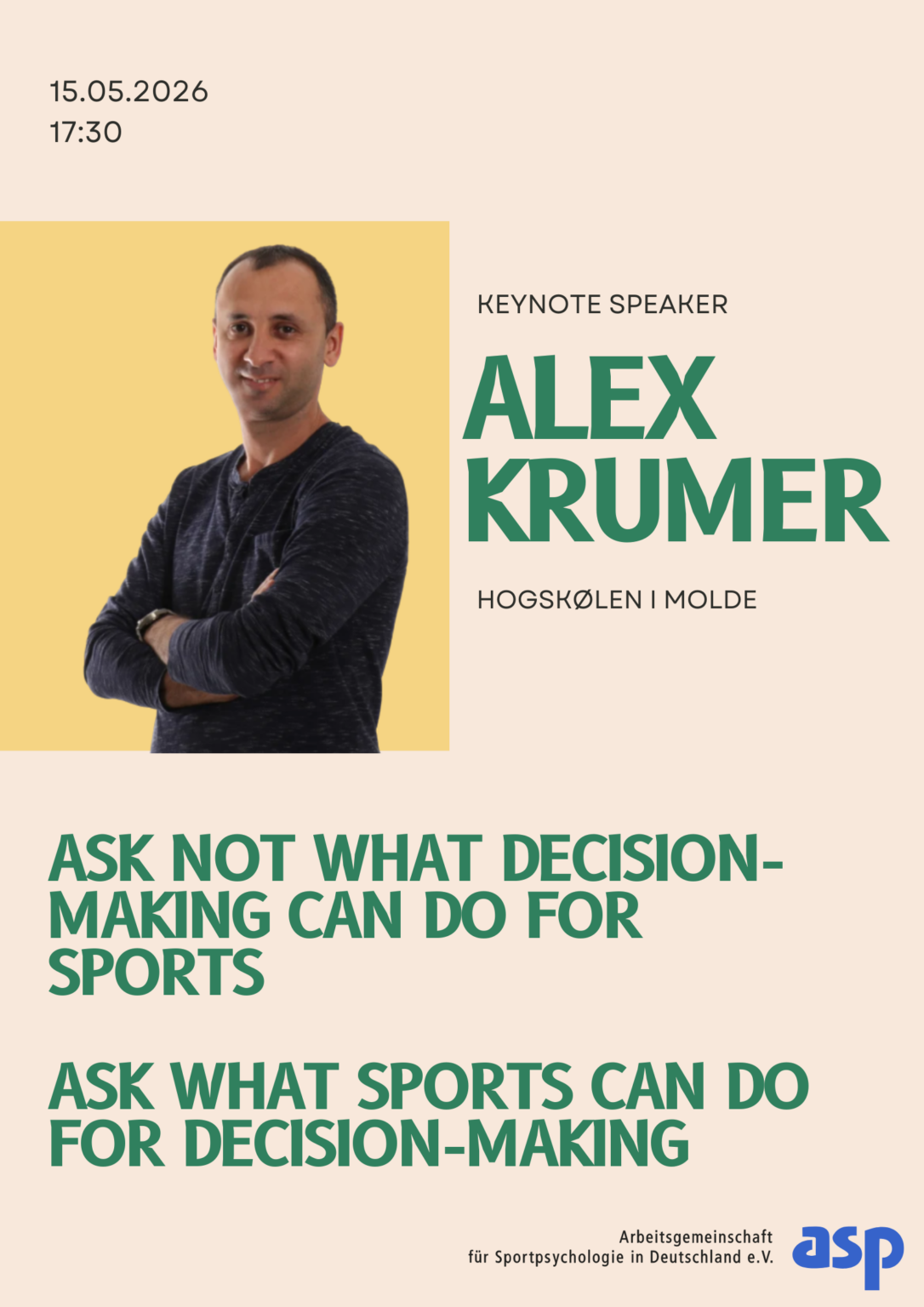
There are two ways to look at the relationship between decision-making and sport. The first is decision-making of sports, where decision-making is used “in the service” of sports industry to analyze profitability of clubs, attendance demand, etc. However, the aim of this presentation is to concentrate on decision-making in sports. Or in a paraphrase from the inaugural address of John F. Kennedy we ask not what decision-making can do for sports, but what sports can do for decision-making. That approach follows the idea that if stones falling from towers and apples from trees are useful for physics, then data from sports competitions may be useful for decision-making (Palacios-Huerta, 2014). The reason for such usefulness is that nature rarely creates a situation that allows a clear view of different phenomena because of the complexity of the real-world. However, sports data allow to overcome such obstacles by providing an excellent laboratory to study human behavior in real competitive environments. The importance of “decision-making in sports” cannot be better expressed than the following quote from a Nobel Prize Laureate Daniel Kahneman (2008) does: “Studying sport is a great idea, because people make many decisions that matter enormously to them under standard conditions. It is actually one of the best places to do this”.
To summarize, in this presentation I will list the advantages of using sports data for decision making research. I also provide a rich overview of literature that used sports data to test different fundamental theories as well as articles that presented divergences of economic decision making from neo-classical theories.
Ausgehend von der Faszination Bewegung und den Möglichkeiten der naturwissenschaftlichen Betrachtung einerseits und der phänomenologischen andererseits werde ich zunächst Handlungsfähigkeit im Kontext Bewegung und Sport definieren. Darunter verstehe ich die Fähigkeit einer Person, aus ihren Werthaltungen und Bedürfnissen die für sie adäquaten Sinnmomente sportlichen Handelns abzuleiten, sich darauf begründete Ziele zu setzen und diese mit dafür zweckvollen Mitteln (Handeln) zu verfolgen, um schließlich die Folgen des Handelns auf allen angesprochenen Ebenen zu reflektieren. In einem weiteren Schritt werde ich ein Modell der Entwicklung von Handlungsfähigkeit vorstellten und mit weiteren psychologischen und pädagogischen Modellen in Beziehung setzen. Da Handlungsfähigkeit nur mit Bezug auf konkrete Kontexte relevant erscheint, nehme ich in der Folge verschiedene Kontexte wie gesundheitssportliches- und leistungssportliches Handeln sowie Trainer:innenhandeln in den Blick und werde diese mit empirischen Daten und Interventionskonzepten in Beziehung setzen. Aus diesen Überlegungen möchte ich zuletzt interdisziplinäre Bezüge insbesondere zur Sportpädagogik und Trainingswissenschaft ableiten sowie mögliche Perspektiven aufzeigen.
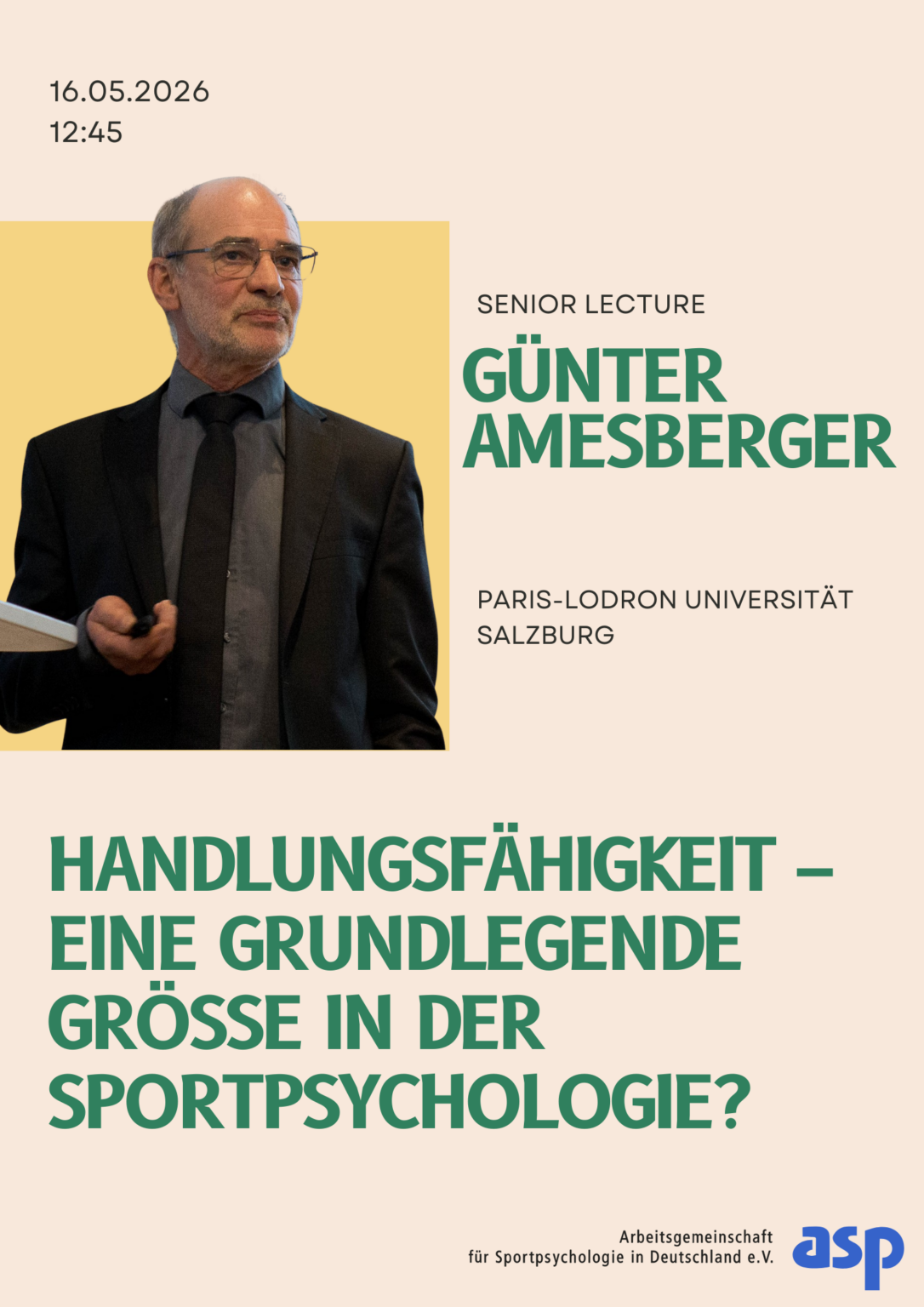
Günter Amesberger hatte von 2005 bis 2024 den Lehrstuhl für Sportpsychologie und Sportpädagogik am Fachbereich Sport- und Bewegungswissenschaft der Universität Salzburg inne.
Er absolvierte an der Universität Wien ein Lehramtsstudium in Leibeserziehung, P.P.P. (Psychologie, Philosophie und Pädagogik) mit dem Nebenfach Mathematik sowie ein Hauptstudium Psychologie, in dem er 1988 promovierte. Es folgten die Habilitation mit der Venia ‚“Sportpsychologie“ (1993) und die Lehrbefugnis „Sportpädagogik“ mit dem Ruf an die Universität Salzburg (Lehrstuhl für Sportpädagogik, der um den Bereich der Sportpsychologie erweitert wurde). Er hat Fortbildungen in verschiedenen psychotherapeutischen Schulen absolviert und ist Lehrtherapeut für Biofeedback und staatlich geprüfter Skilehrer. Er ist Mitbegründer des ÖBS (Österreichischen Bundesnetzwerks Sportpsychologie) und der ioa (integrative Outdoor-Aktivitäten® Verein für natur- und bewegungsbezogene Person-, Gruppen- und Organisationsentwicklung).
Forschungsschwerpunkte waren Psychologie der Bewegung, sportpsychologische Diagnostik (three system approach), Psychophysiologie im Sport, Wirkungen körperlicher Aktivität bei Erwachsenen und Personen in höherem Alter (Vitalität, Fatigue, Emotion, HRV, …), Unfallforschung, psychologische Aspekte des Schulsports, kompetenzorientiertes Unterrichten und Bildungsstandard, Emotionen und Demokratiebildung im Schulsport sowie handlungsorientiertes Lernen. Als angewandter Sportpsychologe hat er verschiedenste Sportarten (insbesondere Rudern, Skilauf, Segeln und Fußball) betreut und an den Olympischen Spielen von 1996-2016 als Psychologe teilgenommen.